 “There is little doubt that the Semantic Web is an engineering success. […] However, as a scientific field, have we discovered any general principles? Have we uncovered any universal patterns that give us insights into the structure of data, information and knowledge?” These and similar questions were posed by Frank van Harmelen (University of Amsterdam) in his awesome keynote speech at ISWC 2011 in Bonn (Germany).
In his presentation, van Harmelen played with the idea of considering research in Semantic Web as a proper science and imagined which laws about the information universe could be derived from our study, just like laws in the physical universe.
I choose this topic to initiate a series of sessions that we are starting at the Ontology Engineering Group, called “Reading Club Over Coffee meetings“. The aim of these sessions is to discuss informally any interesting paper, blog entry, or videocast related either to our particular research topics or to science or research in general. These short meetings are monthly and take place on Fridays right after lunch with no fixed duration (well, the duration of one or two coffees).
 So, around a table, with warm coffee in front of us, Filip Radulovic, Almudena Ruiz-Iniesta, Alejandro Llaves, Idafen Santana, Pablo Calleja, Freddy Priyatna, Lupe Aguado, María Poveda, and myself met for one hour and debated informally around van Harmelen’s ideas. As chair of the session, my only duty was to select some questions and to articulate the debate around them:
1. What is the MOST interesting, appealing, motivating, idea contained in the talk?
2. Do you DISAGREE with something in the talk?
3. What can be the IMPACT of this view in your own research?
I have to say that the debate was exciting and had very inspired contributions from everyone. Actually it was still alive some days later in some other coffee talks! In the rest of this post I will try to summarize the main debated arguments, although (sorry about that) omitting many details.
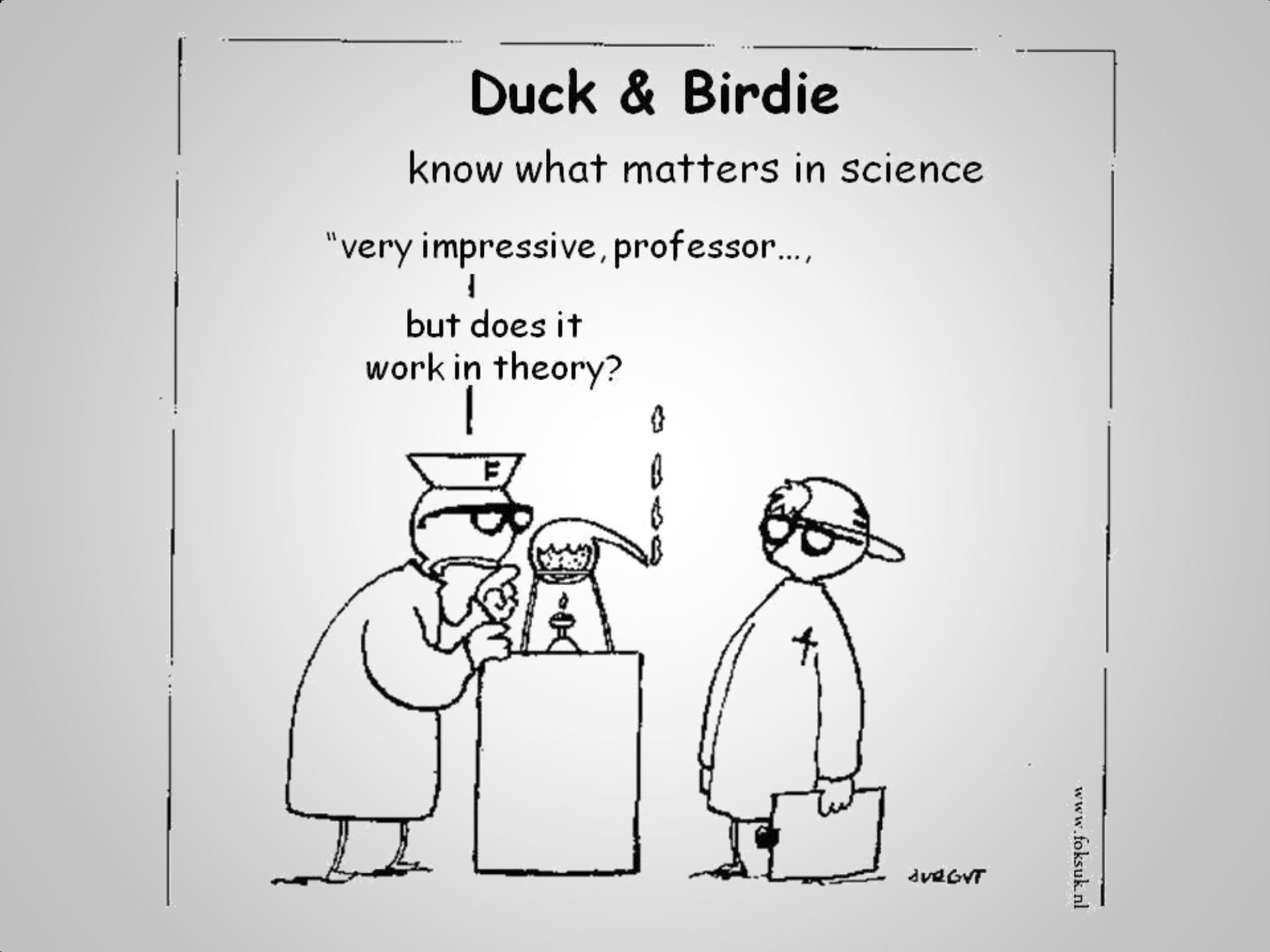
In general, we all agreed that one of the most interesting aspects of van Harmelen’s proposal is the view of the SW study as a science, and the mental exercise that he did of taking its first 10 years of history as an “experiment“. What could be inferred if the experiment could be repeated again and again? María and Lupe liked particularly Frank’s consideration of vocabularies as “pillar” in the SW.
In the talk, a few laws were proposed (eg.: factual knowledge is a graph, conceptual knowledge a hierarchy, and the former is much bigger than the latter). Some of us thought, however, that these are not proper “laws”: this is how the SW looks like here and now, maybe it is not repeatable always. Notice, though, that not even van Harmelen considered them as laws strictly speaking, it’s just a mental exercise! In fact, “to derive a law one experiment is not enough” as Filip stated. Alejandro disagreed in particular with the law of “publication distributed/computation centralized”, as nowadays computation is moving towards being highly decentralized as well.
The biggest debate came around the notion of engineering vs. science. At the extremes were Filip (“Computer Science is not a science”) and Idafen (“Computer Science in general and SW in particular are science, since you can apply the scientific method to them”), and the rest situated all along this spectrum. From María: “not everything in Computer Science is science, e.g. programming”. Freddy: “people created SPARQL first as engineering (to solve a problem), and science came later (studying query complexity and so on)”.
In general we all agreed on the fact that “THERE IS science in Computer Science and Semantic Web” (e.g., information theory). But we did not reach an agreement on whether Semantic Web IS a science or not. The debate still continues… However we all have the perception that most of our work in the area have been about technical issues rather than about inferring laws, thus confirming van Harmelen’s initial intuition.
Finally we asked ourselves about the impact of van Harmelen’s view in our future work. There was no clear answer in general, although the talk invited us to be more conscious about the division between theory and practice, which could have an impact in the way we communicate our research results. In addition, I missed more work in our area that treats the SW as an object of study itself, as an ecosystem that evolves and is subject of certain laws (or regularities, better said). A good analogy to this would be the work done by Barabasi when studying Internet and the Web as “scale free networks”.
The next session of our reading club (Filip will chair) will be titled “What do you think about that, Siri?” and will treat the work of Douglas Hofstadter. Looking forward to it!